Materials Forming and Processing Laboratory, Institute of Industrial Science, The University of Tokyo

日本語 / English

RESEARCH

Research

From microstructure to manufacturing innovation

Top > Research

From “Why Materials Deform” to “How We Process Them”

Understanding metal deformation from microstructure
and designing manufacturing processes

At the Furushima Laboratory, we seek to understand plastic deformation from the viewpoint of what is happening inside the material, and connect that understanding to the question of how manufacturing processes should be designed.

We investigate heterogeneous deformation at the grain scale, surface roughening, fracture, recrystallization, and texture through experiments, measurement, and numerical modeling. We then use FEM, crystal-plasticity FEM (CPFEM), surrogate modeling, and optimization to design and improve forming processes such as deep drawing, tube forming, and dieless forming.

Research concept of the Furushima Laboratory: from understanding why materials deform to designing how they are processed View larger ↗

Current Research Areas

Direct comparison between experiment and CPFEM for heterogeneous deformation and the evolution of surface roughening
01

CRYSTAL PLASTICITY

Crystal Plasticity & Heterogeneous Deformation

We investigate how crystal orientation, grain boundaries, and grain-to-grain interactions generate local strain and surface displacement.

EBSD / DIC / CPFEM / Polycrystal
In-situ observation of local deformation and free-surface roughening
02

FRACTURE & ROUGHENING

Surface Roughening, Localization & Ductile Fracture

We study how microscopic deformation heterogeneity develops into surface roughness, local necking, void growth and coalescence, and final fracture.

Surface profile / Localization / Fracture
EBSD microstructure and recrystallization evolution in ZM21 magnesium alloy
03

MICROSTRUCTURAL EVOLUTION

Microstructural Evolution & Recrystallization during Processing

We examine how temperature, strain, strain rate, local heating, and electrically assisted conditions affect recrystallization, grain size, boundaries, and texture.

DRX / Texture / Mg alloys / EBSD
Surface-roughening evolution, in-situ observation, and finite-element modeling in micro precision sheet forming
04

MICRO PRECISION FORMING

Micro Precision Sheet Forming & Size Effects

We study how grain size, initial surface roughness, and wrinkling become more influential as sheet thickness and part dimensions decrease, and how this affects formability and fracture.

Micro cup / Size effect / Surface roughening / Wrinkling
FEM analysis and process design for multi-stage deep drawing
05

PROCESS DESIGN

Process Modeling, Design & Optimization

We use FEM and surrogate models to predict forming behavior and design and optimize forming conditions and multi-stage process routes.

FEM / Surrogate / Optimization / Process design
Metal tubular microneedle and advanced microforming technologies
06

ADVANCED FORMING

Creating New Forming Technologies

We develop unconventional forming processes for microtubes, microneedles, bellows, and other components by exploiting local heating, material response, and flexible process control.

Microforming / Dieless forming / Tubes / Needles

From Individual Grains to Surface Roughening and Fracture

Microstructure → Deformation → Fracture
Direct comparison between experiment and CPFEM for the evolution of free-surface roughening, including crystal microstructure, surface morphology, and surface profiles View larger ↗

Direct comparison of surface-roughening evolution between experiment and CPFEM

FREE SURFACE ROUGHENING × CPFEM

Directly comparing experiments and CPFEM to track the evolution of surface roughening

On the free surface of a polycrystalline metal, surface undulations develop as plastic deformation proceeds. We reconstruct the actual grain geometry and crystal orientations obtained by EBSD in a CPFEM model, then follow the same region in experiment and simulation to compare the evolution of crystal microstructure, surface morphology, and surface profiles directly.

Our recent work has shown quantitatively that local sinking and rising of the free surface cannot be explained only by the primary slip system of each grain. Grain-to-grain interaction and the activation of non-primary slip systems are also important. We are extending this understanding from surface roughening toward local deformation and fracture.

EBSDCPFEMSurface rougheningGrain interaction
Related paper: Materials & Design 260 (2025), 114975 →
In-situ observation of free-surface roughening View larger ↗

In-situ Observation & Local Deformation Measurement

We combine compact testing systems, 3D surface measurement, and DIC to capture the time evolution of surface topography, strain localization, and fracture.

MEASUREMENT TECHNOLOGY FOR LOCAL DEFORMATION

Laser-speckle DIC for Capturing Local Deformation

We developed a DIC method using laser speckles to measure full-field strains non-contactingly in situations where painted speckle patterns are difficult to use, such as thin foils or elevated-temperature deformation. This enables us to capture not only the final test result but also how deformation localization evolves, providing a measurement basis for tracking surface roughening, local necking, and fracture.

Related paper: Materials & Design 191 (2020), 108626 →
Digital image correlation using laser speckles
MEASUREMENT VIDEO

Laser-speckle DIC

Laser speckles formed naturally by scattering are used as the correlation pattern, enabling full-field measurement of large plastic strains without paint.

NEXT QUESTION

How far can we predict the transition from roughening to fracture?

We aim to connect surface roughening, local necking, and void growth/coalescence from the common viewpoint of deformation localization and build microstructure-based models of ductile fracture.

Capturing and Controlling Microstructural Evolution during Processing

Thermal history × Strain history × Microstructure
CDRX-related microstructural evolution during electrically assisted tension of ZM21 magnesium alloy View larger ↗

Ongoing research on CDRX-related microstructural evolution during electrically assisted deformation

ELECTRICALLY ASSISTED DEFORMATION × CDRX

Connecting local thermal and deformation histories with dynamic recrystallization

During electrically assisted tensile deformation of ZM21 magnesium alloy, temperature, current density, and local strain rate are spatially non-uniform, and these local histories influence grain refinement and the development of low-angle boundaries.

We combine DIC-based local deformation measurements with EBSD characterization and physically based modeling using internal variables such as dislocation density and boundary evolution to describe changes in flow stress, grain size, and low-angle boundary fraction.

Mg alloyEAFDICEBSDCDRX

LOCAL HEATING × DYNAMIC RECRYSTALLIZATION

Using non-uniform fields in dieless drawing to control the microstructure of Mg alloys

In locally heated dieless drawing, heating and deformation change both spatially and temporally. For ZM21 magnesium alloy, our continuous observations showed that the relative contributions of twinning, slip, twin-DRX, and CDRX vary with process conditions. We are now extending this work from simply accommodating non-uniform histories toward actively exploiting them for grain refinement and texture control.

Related paper: Journal of Magnesium and Alloys 10 (2022), 730–742 →

Micro Precision Sheet Forming & Size Effects

Micro scale × Size effect × Formability
Surface-roughening evolution, in-situ observation, and finite-element modeling in micro precision sheet forming View larger ↗

Surface-roughening evolution, in-situ observation, and finite-element modeling in micro precision sheet forming

MICRO PRECISION SHEET FORMING

Clarifying what changes when forming reaches the micro scale

As sheet thickness and product dimensions become very small, the relative influence of grain size and initial surface roughness increases markedly. Phenomena that are often averaged out in conventional macroscopic forming become visible, and the links among heterogeneous deformation, surface roughening, fracture, and forming limits become much more important.

We study these issues mainly through micro deep drawing and related precision micro sheet-forming processes. By combining experiments with finite element analysis and material models that account for grain size, surface roughness, and heterogeneous deformation, we aim to quantify size effects and to understand why wrinkling, roughening, and fracture become critical at the micro scale.

Micro press formingSize effectSurface roughnessFormability

Beyond Prediction: Designing Forming Conditions and Process Routes

Simulation → Surrogate → Optimization

MULTI-STAGE DEEP DRAWING

Optimizing multi-stage deep drawing as a sequence of process states

In high-aspect-ratio cup forming, thickness, work hardening, geometry, and contact conditions generated in one stage are inherited by the next. We therefore treat a four-stage drawing/redrawing process stage by stage and construct surrogate models that predict both process continuation and thickness evolution.

Large numbers of candidate routes are screened rapidly using an FEM database and surrogate models, followed by high-fidelity FEM re-analysis and experimental verification with actual tooling. The aim is to move from simply predicting forming results toward systematically proposing viable process routes.

Deep drawingFEMSurrogate modelOptimization

Ongoing research on surrogate modeling and optimization of multi-stage deep drawing

Creating the Forming Process Itself

Flexible forming × Micro manufacturing

Some manufacturing challenges cannot be solved simply by making conventional dies smaller: micro-scale forming, flexible low-volume production, and materials that deform only at extremely high temperatures require new process concepts. We develop new forming processes by exploiting local heating, superplasticity, buckling, and flexible control of the deformation field.

Metal microtubes fabricated by dieless drawing View larger ↗

Metal Microtubes

By combining local heating and tension, we fabricate thin-walled, small-diameter metal tubes without dedicated drawing dies.

Biodegradable magnesium-alloy microtubes View larger ↗

Biodegradable Mg-alloy Tubes

We pursue large reductions in cross section together with microstructure control for potential applications to medical microtubes and stents.

Metal tubular microneedle View larger ↗

Metal Tubular Microneedles

By deliberately using controlled fracture—reversing the usual idea of avoiding breakage—we create metal needles whose diameter decreases sharply from the root to an ultrafine tip.

Dieless bellows forming View larger ↗

Dieless Bellows Forming

By locally heating and compressing a tube while deliberately controlling buckling, we form continuous bellows geometries without dedicated external dies.

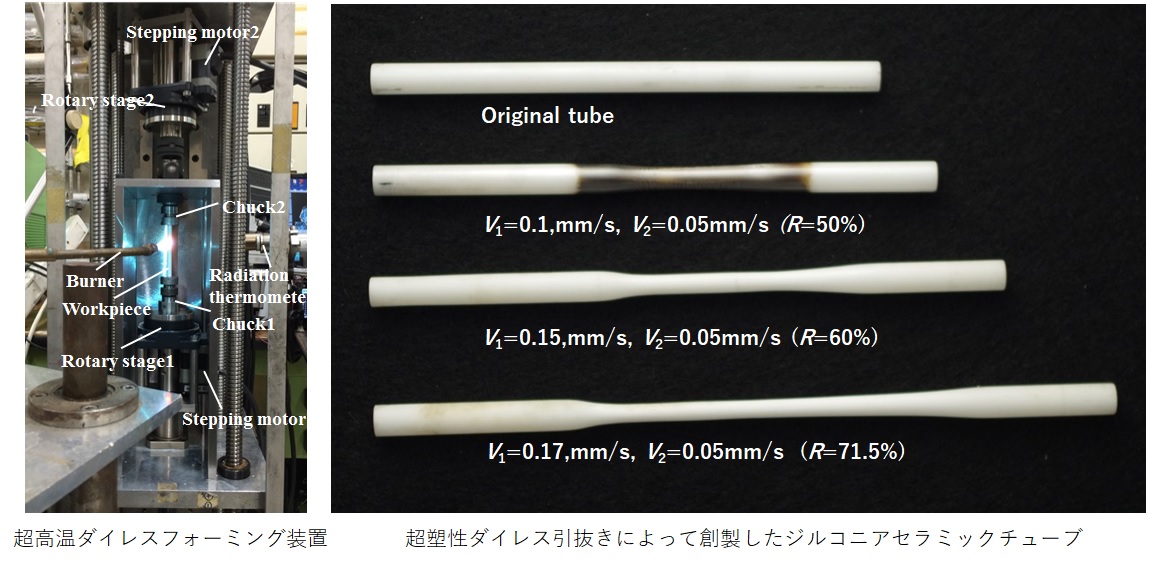
Superplastic dieless forming of fine zirconia ceramic tubes View larger ↗

Superplastic Dieless Forming of Ceramic Tubes

Ceramics are generally brittle, but fine-grained zirconia can exhibit very large superplastic deformation at elevated temperatures. A major challenge is that the superplastic temperature range is approximately 1400–1700°C, where conventional forming dies are difficult to use.

We therefore combine localized heating using an acetylene burner with dieless forming, enabling zirconia ceramic tubes to be reduced in diameter without dies at temperatures around 1700°C. The approach is aimed at flexible and economical manufacturing of fine ceramic tubes.

See the forming phenomena in motion

In dieless forming, local heating and the motion of the material are part of the forming principle itself. Video makes these process concepts easier to understand.

DIELESS FORMING

Dieless Bellows Forming

Local heating and controlled compression induce buckling in selected regions, enabling continuous bellows formation without external dies.

SUPERPLASTIC FORMING

Superplastic Dieless Forming of Ceramic Tubes

Superplastic deformation at ultra-high temperatures enables fine ceramic tubes to be formed without conventional dies that would be difficult to use in such temperature ranges.

Connecting Experiment, Characterization, Modeling, and Process Design

01

Experiment

Tensile testing, deep drawing, tube forming, and microforming. When necessary, we also design and build testing systems and experimental fixtures.

02

Characterization

EBSD, DIC (including laser-speckle DIC), SEM, confocal laser microscopy, and 3D surface measurement are used to visualize local deformation and microstructural evolution.

03

Modeling

FEM, CPFEM, physically based constitutive models, and recrystallization models are used to describe observed phenomena quantitatively.

04

Process Design

Surrogate models and optimization are used to design forming conditions and process routes that achieve target geometry and quality.

Explore Our Research in More Detail

From phenomena inside materials
to new manufacturing technologies.

Your starting point can be experiments, simulation, microstructure, or process design. We welcome curiosity from different directions.

How to Join →
Back to top